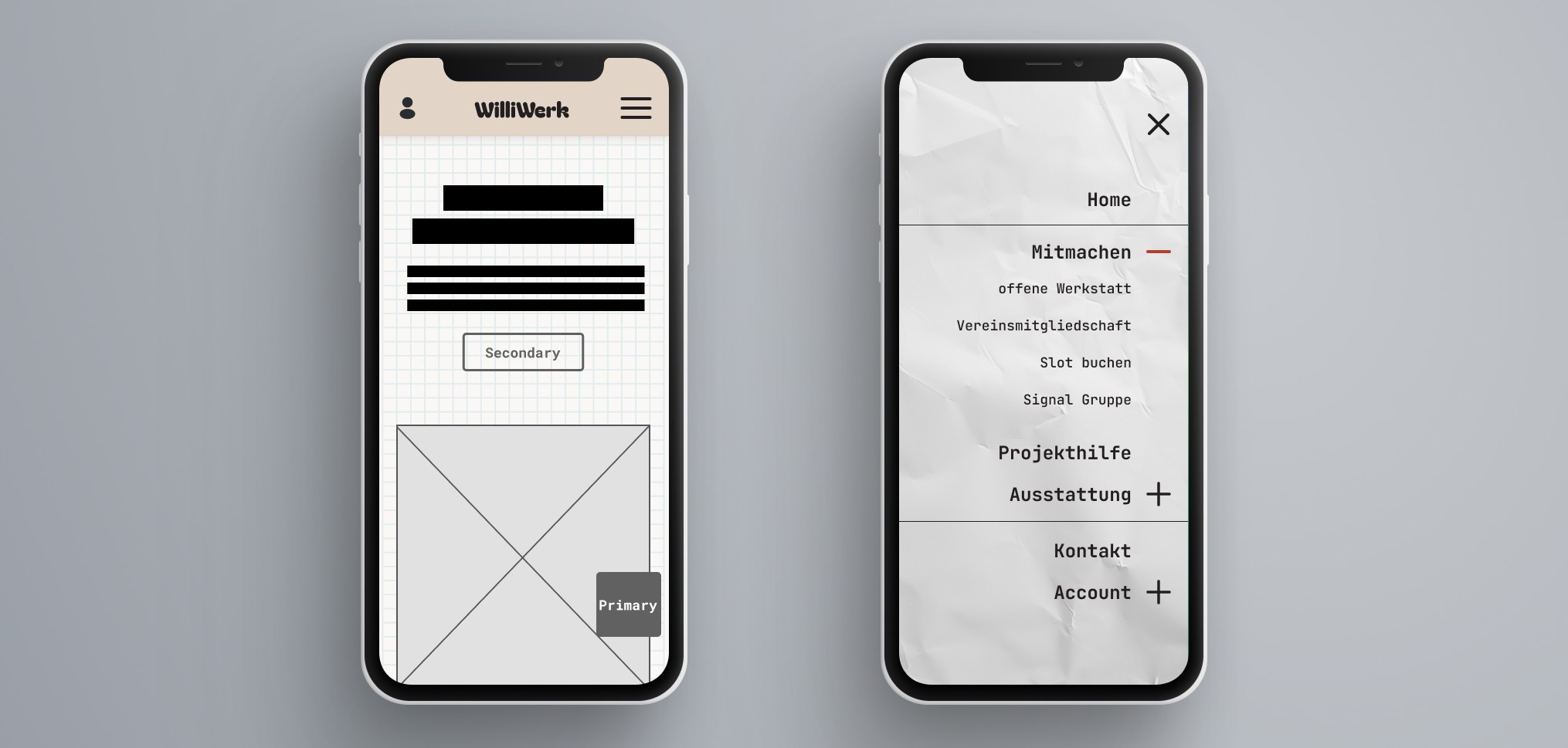
work in progress – between Wireframing and Prototyping
Reducing social entry barriers in communal workshops
Year
2026
Time Scope
3,5 months
Key Skills
UX Research
Wireframing
Prototyping
Tools
Figma
Adobe Photoshop
ChatGPT, Claude & Gemini
Leonardo AI
About
WilliWerk is the community workshop that will be created as part of our housing cooperative project in the future Elbinselquartier in Hamburg-Wilhelmsburg. I’m part of this project myself, which gives me direct access to future users, but also special responsibility, as I’m designing for people I’ll be living with.
The workshop will be open to the entire neighborhood, but will be relatively small.
The biggest challenge: How do people find the courage to visit for the first time?
This project develops a digital solution for exactly this critical moment: before the first visit, when uncertainty prevents many from even starting.
Team & Role
Product Designer (UX/UI) – solo project, bootcamp capstone
Problem Space
Community workshops have enormous potential for sustainable living and knowledge exchange, but remain difficult to access for many. The barriers are less technical than social.
Key barriers:
• Lack of orientation: people don’t know how to get started
• Invisible expertise: help comes through personal networks; those without connections stay excluded
• Social hesitation: asking strangers for help feels uncomfortable
Research insight:
Even experienced DIY enthusiasts struggle with the “I should be able to do this” barrier. 60% of respondents want an open atmosphere without judgment. Surprisingly: the visibility of other projects hardly mattered – what’s important is knowing who can help.
Persona & Design Question

Luca
is interested in DIY and repairs but has little hands-on experience. She researches online first, observes before asking questions, and prefers seeking help from people she knows. She learns best through collaborative work.
How might we make it easier for Luca to get started, so she feels safe and welcome with both tools and people?
Solution Approach
A digital feature on the workshop website: filterable profiles of workshop users who offer support – including to people from outside.
Why this solution?
Compared to buddy systems, this approach works like a large network: users choose whom to approach themselves and have access to the knowledge of many instead of just one person. Compared to analog bulletin boards in the workshop, the digital solution intervenes before the first visit: when the threshold is highest and many never make it there at all.
Planned user journey:
1. Visit website → 2. Filter profiles by skills → 3. Find matching support → 4. Book slot (optionally together) → 5. Show up confident
Design Strategy
Guiding attention:
Through visual emphasis, I make important interaction points clearly recognizable. Filter results and booking buttons are clearly visible without overwhelming. Using color, size, and whitespace, a clear hierarchy emerges that guides users through the process.
Confirmation as a positive moment:
The booking confirmation should be designed encouragingly, not just inform dryly. Planned: A friendly page with visual representation of the slot, perhaps “Your workshop visit is set. We’re looking forward to seeing you!” and optionally a preview of the chosen support. Goal: convey anticipation and security.
Next focus:
UX writing and onboarding language. I believe that the right words are crucial for whether people feel welcome, especially in this non-commercial, social context.
Planned Success Metrics
Two KPIs:
1) Filter-to-booking conversion: does profile search lead to actual workshop visits?
2) Community growth: do new visitors become active participants and eventually helpers themselves?
Market context:
Many open workshops have minimal digital infrastructure: mostly just information, no focus on human connection. Small improvements in onboarding can have major impact.
Risk:
Platform skepticism in the community workshop scene. The tool must feel like infrastructure, not a commercial product.
Reflection & Outlook
What works:
Focusing on the moment before the first visit created a concrete design challenge. Research clearly shows: social barriers are the main problem. The solution addresses both: practical and emotional needs.
Next steps:
Prototyping interface details, developing and testing UX writing, usability tests with potential users.
This project is personally meaningful to me and professionally challenging. I’m designing for people I’ll be living with. The real measure of success will be whether WilliWerk becomes a place where people actually feel welcome and empowered.